See chemistry happen, frame by frame
This is the play-by-play companion to the leaderboards and Chemistry → Winning. The other tabs aggregate chemistry across whole tournaments; this one zooms all the way in, to a single play, frame by frame. For every play below, our tracking transformer (trained on PFF tracking) emits two per-frame probabilities:
- P(score next 10s): calibrated probability the team currently in possession scores in the next 10 seconds, conditional on the full 22-player state. Base rate across all frames ~0.5%; build-ups that lead to goals typically peak around 3–15%.
- P(concede next 10s): calibrated probability they concede.
The model also tells us which players the ball token is "watching" (attention). Step through the slider: yellow halos and yellow lines show the top-3 attended players at that frame. As the play develops, you can see chemistry happen: defenders pulled, off-ball runs that move the probability before anyone touches the ball, an assist's attention transferring to the shooter.
Case studies: the other three semifinalists
The four semifinalists were the four densest chemistry networks in the tournament, and each one looked different. The developed case study, Argentina's nucleus, is on Chemistry → Winning. The three below are earlier drafts we're still rebuilding to that standard; treat the numbers and narratives as provisional.
France: the network (TCD rank 1)
France ran the deepest, most distributed chemistry of the tournament. They didn't depend on one player. The visible top edge by AW-JOI in the squad we have on record is Mbappé + Hernandez (1.16), not Mbappé + Griezmann. Mbappé + Dembélé and Tchouaméni + Rabiot sit in the top tier, with strong cross-team pairs anchoring the midfield-to-attack flow. Where Argentina is a star with orbitals, France is a graph: edges spread across the squad with no single hub.
France's distributed network
Pitch-positioned pair graph (GKs excluded). Orange = off↔off, blue = def↔def, purple = cross. Notice how the strong edges don't all meet at one node; the network is broad.
Why this clip: France break in transition and the model's attention snaps across the squad. Mbappé, Hernández and Dembélé all light up before the ball leaves Mbappé's foot. The shape is the chemistry.
Morocco: the wall that fed the attack (#2 in total defensive mass · only Argentina ahead)
Morocco made the semi-final on a wall, and the data backs it harder
than the popular narrative did. By
total defensive mass, the sum of every
def↔def pair's AW-JDI90 across the tournament, Morocco
rank #2 of 31, behind only eventual champions
Argentina (and ahead of France, Brazil and Croatia). Their two
strongest pairs, Hakimi↔El Yamiq and
El Yamiq↔Attiat-Allah, both sit at the
87th percentile of every def↔def pair in the tournament.
El Yamiq is in three of the top five; the wall has a hub.
But the wall by itself doesn't make a semi-final. The bigger half of
Morocco's TCD lives in cross-team chemistry
(def↔mid and def↔att, 72 strong pairs, their own
biggest block): the recycle that turned a defensive structure
into an attacking one. Defenders found midfielders, midfielders found
wide players, the cross arrived, and the off-ball runner was already
in the box. You'll see the whole sequence in the clip
below.
This is where we see what nobody else saw. The published academic analysis of Morocco's run (summary here) was event-based. The authors quote their own limitation:
"The match event data only describes the actions that actually happened in the match but not the actions that players prevented from happening, for instance, by smart runs or clever positioning."
That is exactly the off-ball pinning that defined Morocco's tournament, and exactly what AW-JDI sees directly. Their paper couldn't measure it. Ours does. The blue lattice below is the part of Morocco's chemistry that event-only frameworks are structurally blind to.
Morocco's elite defensive pairs
Top defensive pairs by AW-JDI90 (attention-weighted joint defensive impact per 90, GKs excluded). El Yamiq anchors three of the top five: the wall is literal, a graph with a hub.
How Morocco ranks among the 31
Morocco's own breakdown:
The wall and the recycle
Blue lattice on the left is the def↔def wall (Saiss / Aguerd / El Yamiq / Hakimi / Mazraoui attending to each other). Orange edges running into the attacking third are the def↔att cross-team feeds, the recycle that became the En-Nesyri goal below. Hover any edge for AW-JOI90 / AW-JDI90.
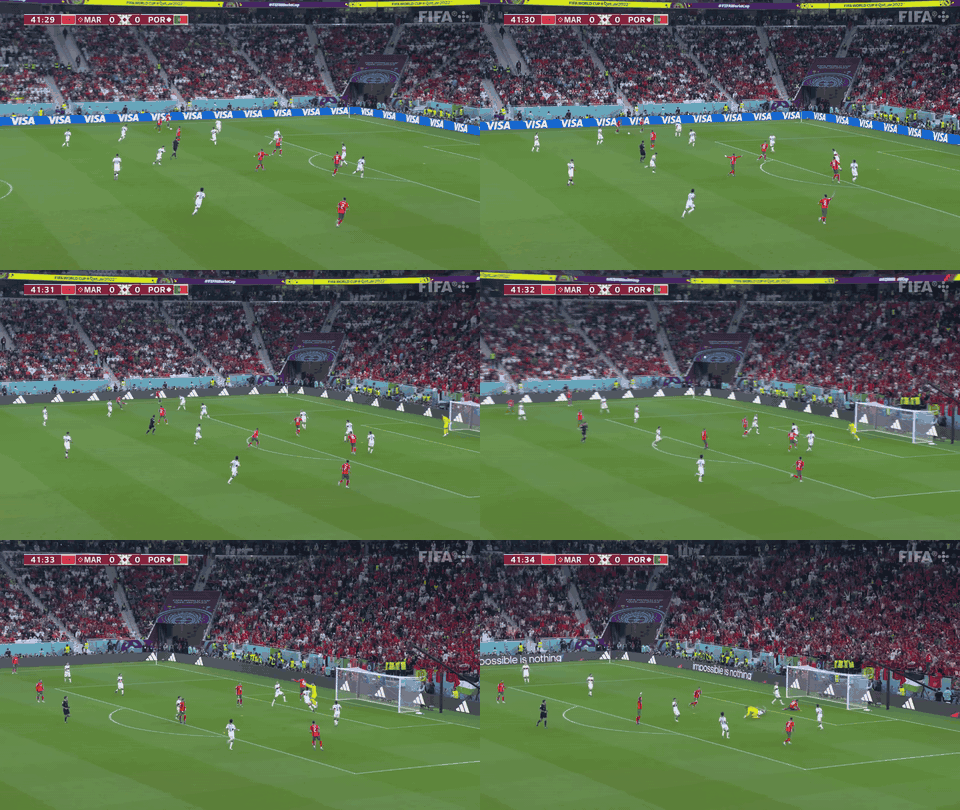
What the interactive play below shows: while the ball is travelling down the left side, the cross-team pair-attention edges from Boufal · Ounahi · Attiat-Allah concentrate on Dias and Pepe, pulling the centre-backs to the ball-side and clearing the central lane for the header. The build-up is the chemistry; the cross is what the lane was opened for.
Open-play header that out-leaped Portugal's back line and Diogo Costa.
Build-up reads like this in the model: Morocco swing it
Ziyech → Boufal → Ounahi
→ Attiat-Allah, and at the moment of the
cross from the left
En-Nesyri's halo lights up. He's pinned between Dias and Pepe,
so the cross-team attention rings the centre-back line, not the ball.
Then the cross arrives and the header goes in.
The defensive lattice above explains the tournament; the clip shows
Morocco when the attention engine was theirs, the half of
Morocco's tournament the published event-based analysis couldn't measure.
Croatia: the engine (TCD rank 3)
Croatia's TCD comes from a midfield-centric off-off subgraph. The Modrić / Brozović / Kovačić triangle drove their tournament. When the model's attention orbits Croatia, it orbits the middle third; the wide players (Perišić, Juranović) hook into it, but the engine room is where the chemistry lives.
Croatia's midfield engine
Pitch-positioned network with the Modrić / Brozović / Kovačić triangle highlighted in gold; non-engine edges muted. Note how every other strong edge in the squad funnels through this trio.
Croatia's R16 equalizer against Japan. The Modrić / Brozović / Kovačić triangle owns the buildup. Attention orbits the middle third for most of the sequence, then snaps wide for the cross. The midfield engine in motion, not a single passing combination.
What chemistry looks like on a pitch
Working definition. Chemistry between two players is the part of the moment-to-moment P(score) − P(concede) signal that is attributable to their joint configuration, not to the ball location or to either player alone. The transformer scores the full 22-player state; the attention map tells us which partnerships the model is conditioning on as that score moves.
Three things to watch while scrubbing:
- P(score) climbs before the ball moves. An off-ball runner that drags a defender opens a passing lane. The model sees this even though no SPADL event has fired; event-level VAEP can't.
- Attention transfers from passer to receiver. On a good combination, the model's attention smoothly hands off from the player on the ball to the teammate about to receive. A yellow line that survives the pass is a "chemistry edge."
- Defensive shape collapses before the goal. P(concede) spikes a beat before the shot because defenders are structurally beaten. Chemistry asks not just "did they score" but "did the build-up force the defence apart together."
How this differs from JOI/JDI
JOI and JDI on the other tabs are event-level: they assign VAEP at every on-ball action and aggregate. Their strength: a clean sum per pair across 64 matches. Their weakness: only on-ball moments get a value. Frame-level VAEP is the same idea applied 5× per second and to all 22 players, chemistry as a continuous trace rather than a tally. The two are complementary: JOI/JDI for season-long rankings, this view for individual partnerships and clip-level storytelling.
Next → the full math for VAEP, JOI, JDI, and the transformer is on Methodology. All raw tables and PNGs are on Downloads.